
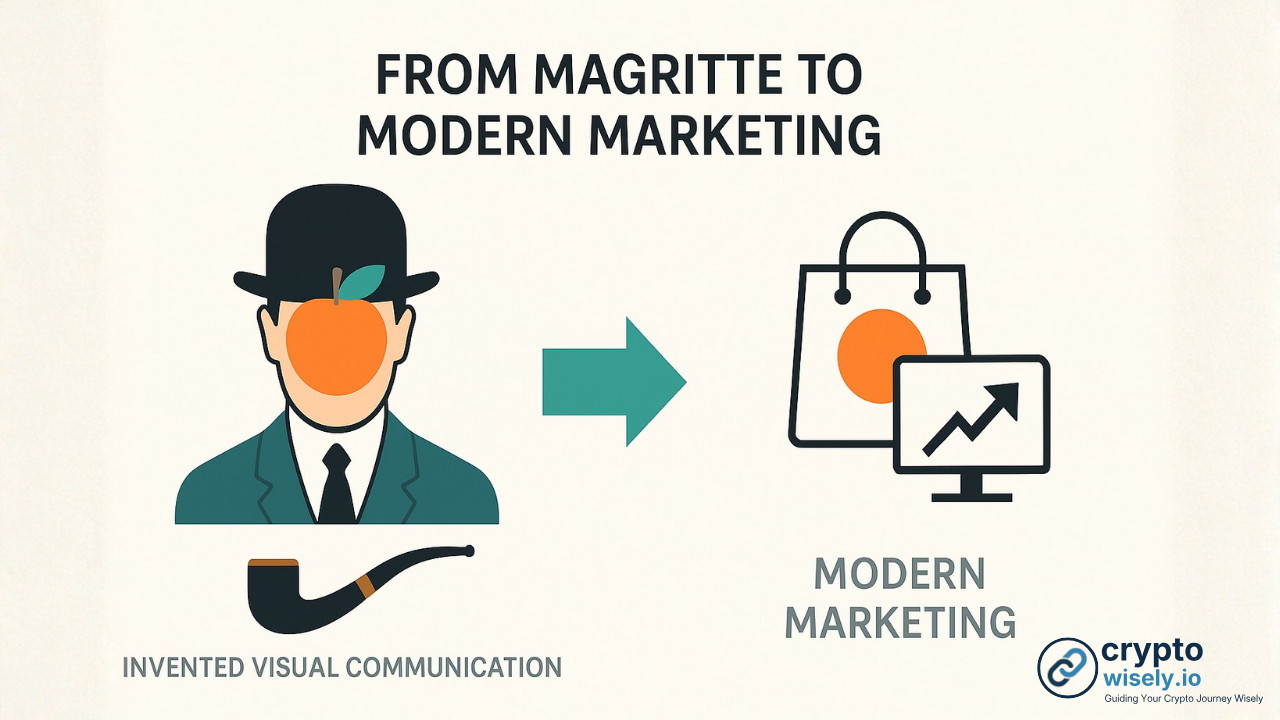
How a surrealist painter accidentally taught brands how perception is engineered
This is a modern marketing and brand strategy lesson in disguise. In any market—tech, fintech, or crypto marketing—the real battle is not the product. It is the frame people use to interpret it.
Marketing history is usually written through agencies, campaigns and corporate milestones. But some of the strongest foundations of modern brand communication came from places the industry never looked — especially from a quiet Belgian surrealist who spent his life questioning what people think they see.
Long before user psychology, neuromarketing or perception design became disciplines, René Magritte was dissecting the mechanics of meaning itself.
This is not an art story. It is a reminder that the greatest marketing breakthroughs often begin outside marketing.
Magritte understood something most brand strategists still underestimate. People do not see objects. They see interpretations.
When he painted the famous pipe with the caption “This is not a pipe,” he was not being clever. He was exposing the invisible layer between object and perception — the mental frame the viewer brings to the image.
That single idea became the foundation of modern branding.
- Luxury is not a product. It is a frame.
- Fintech is not technology. It is a promise of control.
- Crypto is not code. It is a story about possibility.
- SaaS is not software. It is a shortcut to efficiency.
Magritte’s work was a masterclass in how a simple shift in framing can redefine the entire meaning of a symbol.
In marketing terms, he showed that interpretation is more powerful than the thing being interpreted.
Marketers often assume impact requires complexity. Magritte proved the opposite.
Most of his paintings are visually quiet. Flat backgrounds. Clean outlines. Familiar objects arranged in unfamiliar ways.
This aesthetic choice reveals a blueprint for today’s top performing visual communication.
- Minimal but conceptually sharp
- Familiar yet contextually surprising
- Simple forms carrying complex meaning
Tech and Web3 brands follow this rule intuitively. Apple’s blank backgrounds. Meta’s abstract gradients. Crypto companies’ geometric symbolism.
All echo Magritte’s philosophy. Remove noise. Expand meaning. Make the viewer complete the idea.
Before marketers began using words like signifier, anchor text or symbolic cues, Magritte was turning these ideas into visual puzzles.
He demonstrated that symbols gain power through context. Meaning can be engineered. Ambiguity can be a strategic asset. Viewers become participants in the message.
Today this is standard marketing practice. Every strong campaign invites the user to interpret and connect the dots.
Magritte built the template decades earlier.
We are in an era where audiences distrust polished narratives and instantly filter out anything that feels engineered.
Magritte’s work offers a solution not through louder messaging, but through smarter meaning design.
- Shift the frame
- Reveal the unseen layer
- Make the familiar unfamiliar
- Let the idea breathe instead of overwhelming it
This is exactly why his philosophy maps so well to Web3, fintech, AI and emerging tech marketing.
If you enjoyed this lens, you may also like our institutional shift series: The Convergence Layer and the adjacent regulatory angle: The Regulation Layer .
How jurisdiction and enforcement shape distribution, messaging, and growth constraints.
Open hubMagritte teaches marketers to design interpretation, not just communication.
René Magritte never cared about branding. Yet his approach quietly shaped the foundations of how brands speak, how symbols spread and how meaning travels in a noisy digital world.
Maybe the future of marketing will not be invented inside marketing departments. Maybe it will come from artists who understand how humans think, perceive and interpret.
Magritte did not create modern marketing. He just revealed how it works.
Disclaimer: This article is for informational purposes only.