
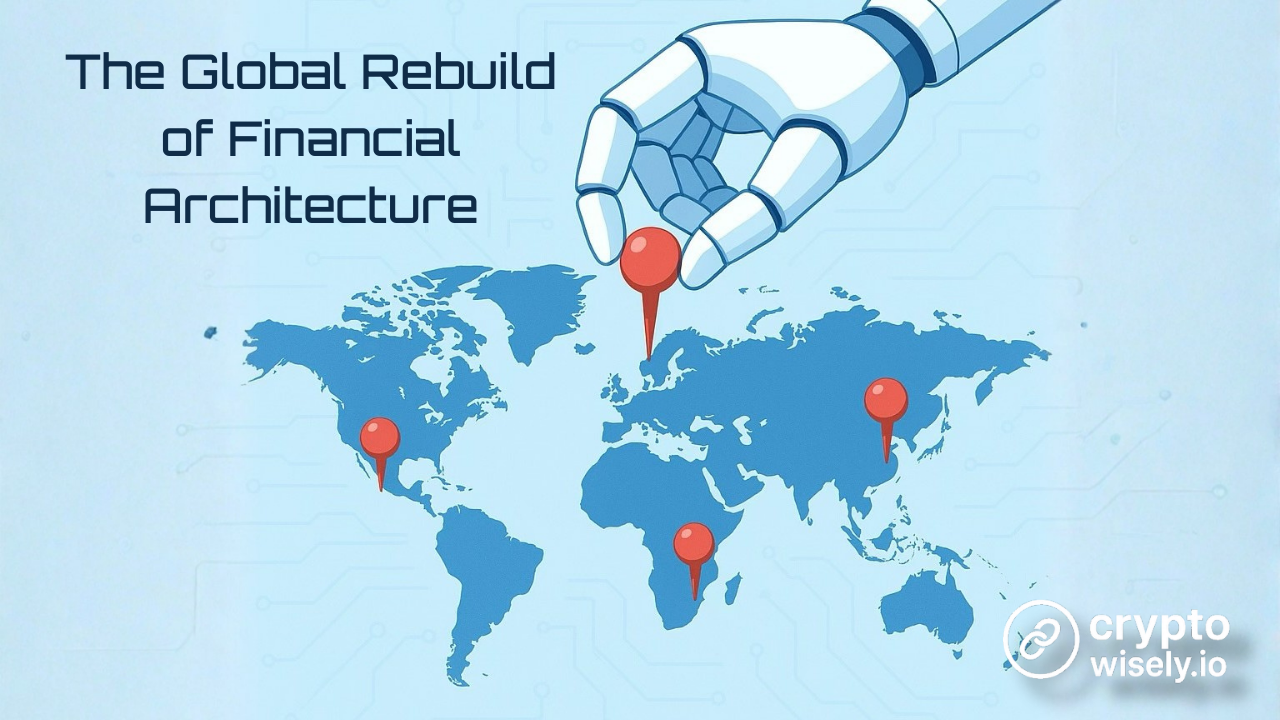
Global crypto policy and risk landscape has shifted in a short window, but the real story is not the headline cycle. It is the underlying architecture moving at once: bank guidance, capital rules, stablecoin settlement, AI payments, and AML velocity risk. When these layers change together, market structure follows.
Below is a structured, region-by-region view of what changed across the United States, Europe, the Gulf region, Africa, and the broader policy environment, and why these signals matter for the next phase of institutional adoption.
- United States: banks move crypto into the operating layer
- Basel: capital framework is being rewritten
- Europe: MiCA tightens, demand still accelerates
- Gulf: Saudi Arabia and Dubai build the next hub
- Africa: stablecoins become a macro tool
- EMVCo: AI agents are about to start paying
- Financial crime: the agility gap
- Market stress: liquidity and sentiment compression
- Synthesis: construction period, not transition
- References and further reading
- FAQ
1) United States: banks are moving crypto into their operating layer
Operational permissions are often misunderstood as “minor” guidance. In practice, they define what banks are allowed to do on day one, and what becomes possible on day ninety. When banks can support blockchain operations in a compliant way, blockchains stop being an experiment and start becoming infrastructure.
- Banks can interact with native assets for network operations
- Settlement workflows begin to migrate on-chain
- Stablecoin utility expands beyond “crypto rails” into treasury and payments
- Compliance frameworks adapt to hybrid operating models
2) Basel and the global crypto policy risk landscape
Institutional adoption does not scale on narratives. It scales on balance-sheet rules. When capital treatment is punitive or undefined, exposure becomes economically irrational. When capital treatment becomes workable, the market can finally treat crypto as an allocatable asset class.
- Pushback from major jurisdictions increases pressure to revise the current approach
- Risk weights and classification mechanics are being reassessed
- Capital design moves from “deterrence” to “control”
3) Europe: MiCA tightens, but demand grows faster
Europe is positioning itself as a credibility filter. That means heavier governance and liability rules, clearer custody expectations, and more defined licensing pathways. The tension is that innovation cycles move faster than policy cycles, which creates recurring bottlenecks.
- Custody requirements trigger implementation debates
- Stablecoin issuance tests accelerate under clearer perimeter logic
- Tokenisation sandboxes advance as “controlled experimentation”
- Governance and liability burden increases for market participants
4) Gulf: Saudi Arabia and Dubai are quietly building the next hub
The Gulf region’s shift is not about being “crypto-friendly.” It is about building institutional-grade infrastructure where global players can operate with licensing clarity, settlement efficiency, and cross-border optionality.
- Stablecoins evaluated as macro-policy instruments, not only market products
- AI and tokenisation convergence becomes a strategic theme
- Regulators position the region as a neutral, operational bridge
5) Africa: stablecoins are becoming a macro tool, not a speculative asset
In inflation-heavy environments, stablecoins behave like money because they solve a real economic problem: access to a more stable unit of account and settlement rail. That pushes stablecoins from “technology story” to macro instrument.
- USD stablecoin usage expands where local currencies are unstable
- Stablecoins substitute weak banking rails in day-to-day settlement
- Hybrid and commodity-linked models gain serious attention
- Dollar dependency becomes both a feature and a policy question
6) EMVCo: AI agents are about to start paying
A subtle but material change: payment standards begin to recognise agents as actors in the payment flow. That implies new authentication and liability models, not just new UX.
- Agents receive cryptographic payment tokens
- Delegated authentication patterns expand (including device and identity factors)
- Merchants verify signatures and token provenance
- Fraud and dispute frameworks adapt to agent-led execution
7) Financial crime: the problem is not intelligence, it is speed
The emerging gap is operational: threat actors iterate faster than institutional update cycles. This is less about “knowing what happens” and more about “responding quickly enough.”
- Criminal networks behave like supply chains
- Cross-chain velocity increases exploit windows
- Layered rails (neobanks + fintech + crypto) widen the attack surface
- Institutions update monthly while threats iterate hourly
8) Market stress: liquidity and sentiment compression
Price drawdowns often get over-interpreted as structural failure. Many episodes are simply liquidity and positioning compression. In practice, these environments are where institutional entry frequently becomes more deliberate.
9) Synthesis: this is a construction period, not a transition period
Put together, the signal is consistent: capital rules, bank operating permissions, compliance expectations, settlement rails, and AI-enabled commerce are being updated in parallel. That is what “construction” looks like in market infrastructure.
The key question is no longer whether the system will converge. It is which institutions position early enough to operate inside the converged stack: policy + custody + settlement + compliance + execution.
References and further reading
- Bank for International Settlements (BIS) for capital, settlement, and market-structure research
- European Central Bank (ECB) for policy signals and macro context
- Related Insight: The Convergence Layer (Banks and Exchanges)
- Related Insight: Custody vs Trading (What banks will offer)
Jurisdiction logic, licensing paths, and compliance-native market access.
Open hubA practical guide to regulated crypto marketing, licensing perimeter, client acquisition, and market-entry sequencing.
Read guideState rails, policy instruments, and how public money shapes settlement strategy.
Open hubSettlement, treasury flows, custody implications, and institutional adoption signals.
Open hubHow exposure products, access rails, and distribution mechanics evolve under policy pressure.
Open hubFAQ
Is this mainly a regulation story or a market-structure story?
It is both. Regulation sets the perimeter, but market structure is the mechanism that turns permission into scalable adoption. The key is whether custody, settlement, capital treatment, and compliance workflows become operationally repeatable.
Where do stablecoins fit in this landscape?
Stablecoins act as settlement instruments across payments, treasury flows, and cross-border rails. Even when banks do not issue stablecoins, they often become the institutional anchor behind liquidity, redemption, and risk controls.
What should institutions watch next?
Watch capital rule revisions, custody standards, and how compliant settlement rails evolve. These determine distribution readiness and whether exposure becomes a standard product.
Disclaimer: This article is for informational purposes and does not constitute financial or legal advice.