
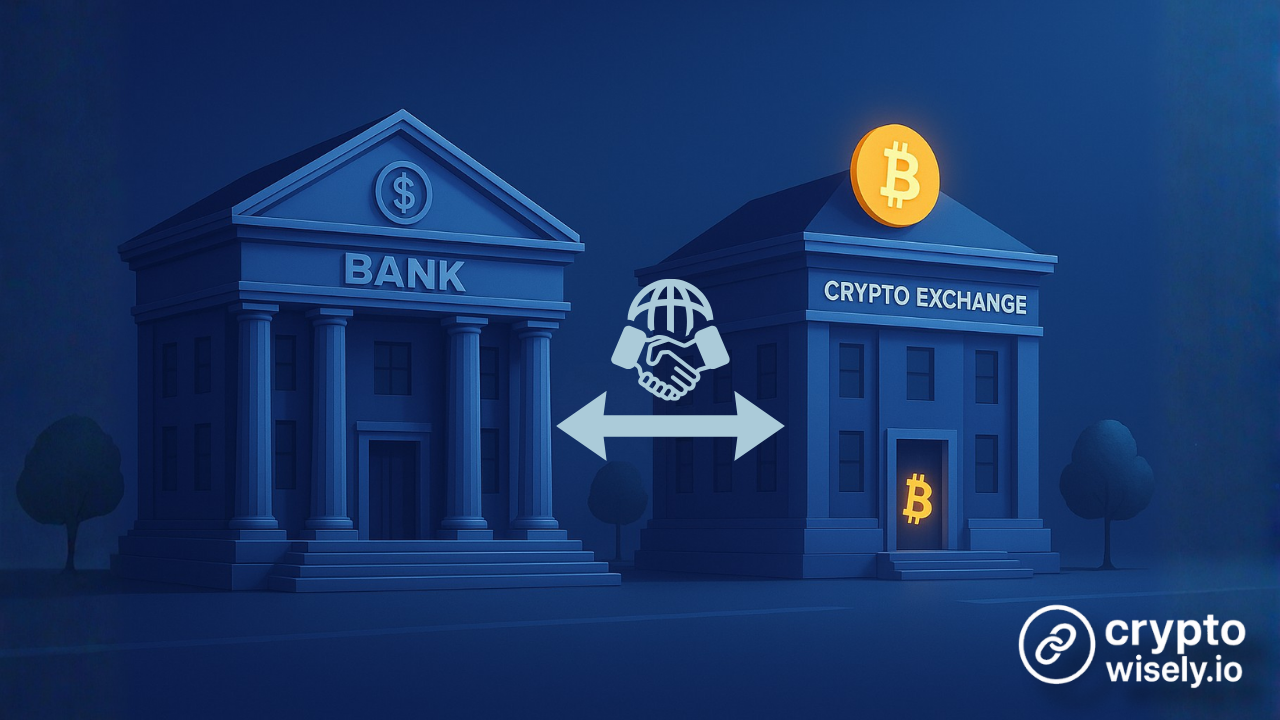
The convergence layer is the quiet center where banks and crypto exchanges are being pulled toward the same operating rails. Not because they want to. Because market structure is pushing them there.
Banking workflows need modern execution and distribution. Exchanges need permission, compliance, and institutional trust. The result is a shared middle layer: custody, compliance, settlement, and liquidity begin to interlock.
1) Banks: crypto became infrastructure
Crypto is no longer a niche playground. It is infrastructure.
- Stablecoin settlement rails
- Tokenized money markets
- Continuous settlement
- Global retail access with near-zero friction
Banks have spent years watching exchanges ship what banks could not build fast enough: always-on liquidity, global onboarding, instant transfers, and frictionless account experiences.
2) Exchanges: scaling needs permission
Scaling without regulation is fragile. Scaling under regulation requires what banks already have: trust. Not marketing trust. Institutional trust shaped by licensing culture, risk frameworks, and regulator relationships.
Exchanges can build technology faster. Banks can secure permission faster. In the next phase, permission becomes a growth engine.
3) Regulation signals: MiCA, VARA, MAS point to the same direction
Regulation is pushing both sides toward interoperable, supervised operating models where stablecoins and tokenized assets behave like financial infrastructure.
- Licensed stablecoins become payment-grade settlement tools
- Tokenized funds normalize on-chain distribution
- Banks scale custody and compliant access
- Exchanges adopt bank-grade controls
- Users move between rails with minimal friction
For an official EU legal reference (primary source), see MiCA as published on EUR-Lex: Regulation (EU) 2023/1114 (MiCA) — EUR-Lex .
4) What the convergence layer actually is
The convergence layer is not banks becoming exchanges, or exchanges becoming banks. It is a shared infrastructure layer where roles specialize:
- Banks handle compliance, onboarding, and regulated custody
- Exchanges handle liquidity, execution, and product velocity
- Stablecoins and tokenized assets become settlement primitives
Cooperation becomes rational because neither side can scale alone in a supervision-first world.
For a practical breakdown of how institutions compare trading venue choices, see: OTC vs Exchange: How Institutions Execute Large Crypto Trades .
5) Winners and losers in a converged market
Winners will not be the fastest movers. They will be the smartest operators.
- Banks that treat crypto as infrastructure, not ideology
- Exchanges that evolve into regulated digital financial ecosystems
- Users who get a frictionless system without choosing sides
Losers are institutions that stay ideological and treat convergence as a battle instead of a structural timeline.
6) Why the next decade changes
The convergence layer reframes what matters: which exchanges survive, which banks lead digital assets, where liquidity concentrates, and which rails become the default for cross-border flows.
The bridging era has already begun. Integration follows. Soon the separation between banking and crypto will feel as outdated as the separation between online and offline.
References
- Regulation (EU) 2023/1114 (MiCA) — EUR-Lex
- Bank for International Settlements (BIS) — market structure and settlement research
Related reading on CryptoWisely
- Custody vs Trading: What will banks actually offer?
- The Regulation Layer: How countries shape crypto visibility
- Global crypto policy risk landscape: what comes next
Disclaimer: This article is for informational purposes and does not constitute financial or legal advice.