
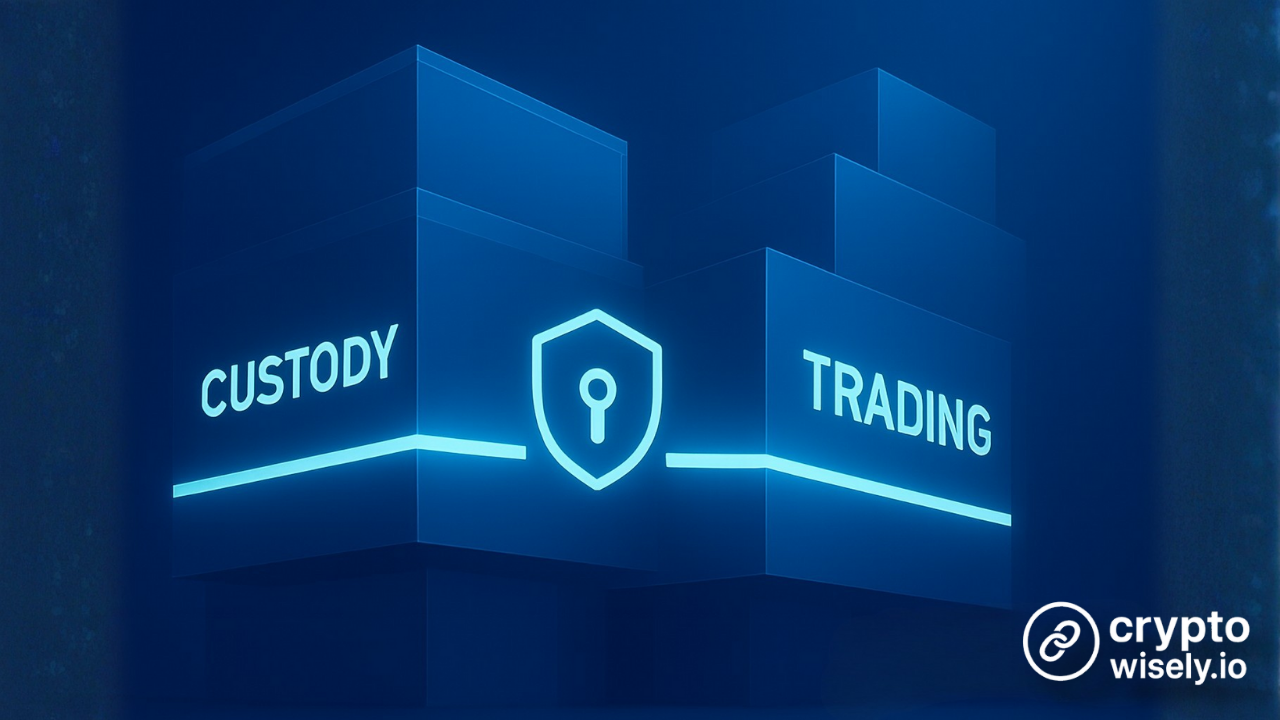
Custody vs. Trading: What Will Banks Actually Offer?
Custody vs trading for banks is often misunderstood. There is a persistent misconception around how the next phase of digital asset adoption will unfold. Many people assume that once regulators give the green light, banks will suddenly behave like crypto exchanges. They imagine banks running 24 hour trading engines, providing deep liquidity, offering spot and derivatives, and competing directly with the platforms that have been building these systems for a decade.
From an institutional perspective, the custody vs trading debate for banks is not about competition, but about how regulated financial infrastructure evolves across custody, settlement, and execution layers.
This assumption ignores how banks actually operate. Banks do not chase innovation for its own sake. They move when three conditions align: the regulatory perimeter becomes predictable, the risk model becomes quantifiable, and the economic incentive becomes repeatable. Only then do banks expand into a new domain. Not earlier.
This is why custody is the natural entry point. Custody fits the rhythm of banking. It is slow, auditable, permission based and built around well defined responsibilities. Banks already operate massive custody divisions for traditional assets. Extending this to digital assets requires new infrastructure but not a new identity. It is still about security, segregation, compliance and the safe movement of client assets. It feels familiar, which means it feels safe.
Trading is the opposite of familiar. Trading is noise, speed, volatility and fragmentation. Trading is a world where liquidity never sleeps, price discovery is continuous, spreads move in milliseconds and flows can invert without warning. This is a world crypto exchanges understand intuitively because they were born inside it. Banks were not.
So when we ask what banks will actually offer, we should expect the answer to reflect their internal DNA rather than external market hype.
Banks will build secure storage, institutional access pipelines, transparent reconciliation systems and integrated reporting frameworks. For large asset managers, this alone is a breakthrough because it allows them to hold digital assets inside familiar compliance structures. Custody alone unlocks meaningful institutional inflows without requiring banks to act as trading venues.
The idea that banks will suddenly run matching engines or high speed liquidity books misunderstands their risk appetite. What they will offer instead is structured exposure. Think of tokenized treasury baskets, regulated stablecoin sets, institutional grade index products or token based representations of low risk financial instruments. These products resemble the ETFs and structured notes banks already distribute. They are simple to supervise, easy to explain and operate within well tested compliance frameworks.
This is the most overlooked part of the story. Banks do not need to mint stablecoins to be central to their operation. Redemptions, treasury flows, collateral checks, credit lines, liquidity management and large scale settlement all require banks in the background. The rails may be blockchain based. The gravity of settlement still belongs to the banking system. Banks become the institutional anchor for stablecoin liquidity without ever acting like consumer facing issuers.
Most users will never see this. Even when a bank offers “digital asset trading” inside its interface, the real execution will often be performed by crypto exchanges acting as liquidity providers. Banks manage identity, risk, compliance and customer relationships. Exchanges handle execution, depth, spreads and price discovery. It is a silent partnership driven by necessity, not branding. Each side stays within its strength.
A practical reference on how trading venue choice affects liquidity access, market impact, custody, settlement and control workflows.
Read execution noteIn the United States, regulatory clarity moves slowly and banks will remain custody first for a long time. In the European Union, MiCA accelerates the development of tokenized products and gives banks a passportable framework to build compliant exposure layers. In the UAE, parallel licensing structures allow banks and exchanges to collaborate openly, producing some of the world’s most hybrid institutional models. In the United Kingdom, the sandbox mechanism is creating a blueprint where custody and execution remain separate but interoperable. For formal context, see EUR-Lex and the BIS.
Exchanges are becoming more compliant because regulation demands it. Banks are becoming more technologically flexible because market structure demands it. The two sides are not meeting in the middle by intention but by natural evolution. Banks extend outward through custody and settlement. Exchanges extend inward through transparency and regulated workflows. The overlap becomes the new architecture.
This is not a race between institutions. It is a shift in the underlying design of financial infrastructure. Custody and trading are no longer rival functions. They are complementary layers that will increasingly operate inside the same digital fabric. The institutions that understand this early will shape the next decade of market structure.
The real question is no longer who becomes the dominant player. The real question is who recognizes that the system is already converging and positions themselves before the architecture solidifies.
Where compliance, custody, liquidity, and execution merge into one system.
Read insightJurisdiction maps, licensing logic, and compliance-native market access.
Open hubSettlement rails, treasury flows, custody implications, and institutional adoption.
Open hubDisclaimer: This article is for informational purposes and does not constitute financial or legal advice.